

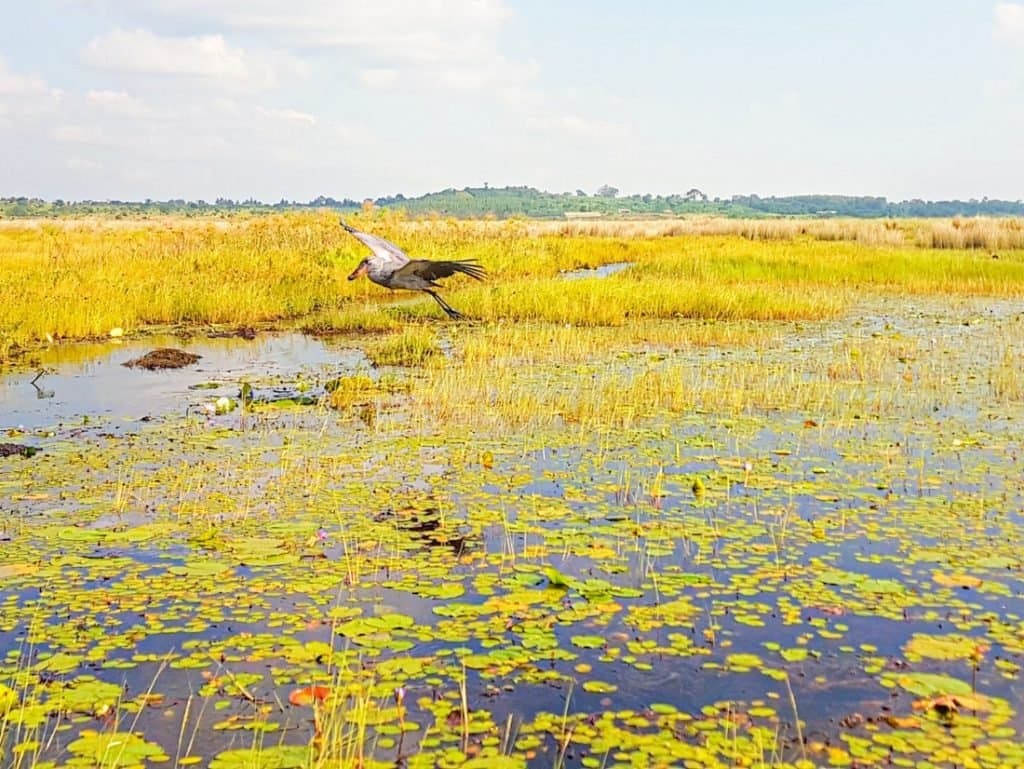
Birding
Birding in Uganda
Uganda packs shoebills, Albertine Rift endemics and Congo-basin forest specials into a country you can cross in a week. We run 5 dedicated birding itineraries, from 7 to 24 days, between them visiting 17 named sites — Mabamba's papyrus, the Royal Mile at Budongo, Mubwindi Swamp in Bwindi, Semliki on the Congo border.
Where the birding is
Each of these is a stop on the itineraries below. The timing note on each comes from the same month-by-month dataset behind our best time to visit guide.
Entebbe & Mabamba
Best December–February and June–August
Mabamba shoebill canoe trips run year-round; calmer water and firmer tracks in the drier windows. Palearctic migrants boost lists November to April.
On 5 of our 5 birding itineraries
Murchison Falls
Best November–March
Shoebill chances on the delta boat are best in the drier months; migrants add depth November to April.
On 3 of our 5 birding itineraries
Bwindi Impenetrable
Best March–May and September–November
Albertine Rift endemics are resident year-round; the wetter months bring breeding activity and full song, at the cost of slippery trails.
On 3 of our 5 birding itineraries
Kibale Forest
Best January–June
The Green-breasted Pitta displays at dawn mainly in the wetter months; Bigodi's papyrus specials show year-round.
On 2 of our 5 birding itineraries
Queen Elizabeth
Best November–April
Over 600 species; Palearctic migrants swell the lists from November to April.
On 1 of our 5 birding itineraries
The birding routes also take in Budongo Forest, Mabira Forest, Semliki, Mgahinga, Fort Portal, Lake Kyoga, Lake Bisina, Ziwa Rhino Sanctuary, Echuya Forest, Rwenzori Mountains, Lake Mburo.
The birding safaris
- 7 days7 Days Birding in UgandaA seven-day birding safari through northern Uganda, taking in Entebbe, Murchison Falls National Park and Budongo Forest Reserve. Designed for keen birdwatchers looking to see a wide range of savannah and forest species.
- 10 days10-Day Birding at the Source of the NileA ten-day birding journey through Uganda's wetlands, forests and savannahs, from the Entebbe shoreline to Murchison Falls National Park, with chances to see the shoebill and many other species.
- 12 days12 Days Albertine Rift Endemics Birding SafariA twelve-day birding expedition through Uganda's Albertine Rift, targeting endemic species across montane forests, swamps and savannahs. It visits Echuya, Mgahinga, Bwindi, the Rwenzori foothills and Semliki with experienced birding guides.
- 14 days14 Days Forest Birding SafariA fourteen-day birding tour through Uganda's forests, from Mabira and Budongo to Kibale, Semliki and Bwindi, focused on rainforest and Albertine Rift endemic species. Chimpanzee and gorilla tracking are available as options.
- 24 days24 Days the Best of Uganda Birding SafariA 24-day birding expedition across Uganda, covering wetlands, forests and savannahs from Mabamba and Lake Mburo through Mgahinga, Bwindi, Queen Elizabeth, Kibale, Semliki, Murchison Falls, Budongo and Mabira. Targets include the shoebill and many Albertine Rift endemics.
Not a dedicated birding trip, but with birding days built in: 16 Day Uganda Rwanda Safari, 15 Days Uganda and Rwanda Wildlife and Cultural Safari.
Common questions
- Where can I see a shoebill in Uganda?
- Mabamba Bay Wetland, the papyrus swamp on Lake Victoria closest to Entebbe, is the classic shoebill site and is reached by canoe. Canoe trips run year-round, with calmer water and firmer tracks in the drier windows. There is a second chance on the delta boat at Murchison Falls, where sightings are best in the drier months.
- When is the best time for birding in Uganda?
- It depends what you are after, and the trade-off runs the opposite way to gorilla trekking. Albertine Rift endemics are resident year-round, and the wetter months bring breeding activity and full song at the cost of slippery trails. Palearctic migrants swell the lists from November to April. The drier windows make the forest trails and swamp tracks easier going.
- Where do I see Albertine Rift endemics?
- In the montane forests along the rift — Bwindi Impenetrable, and the smaller forests at Echuya and Mgahinga that the birding itineraries pair with it. They are resident year-round, so the choice of month is about trail conditions and song rather than whether the birds are there.
- How long does a birding trip to Uganda need to be?
- The dedicated birding itineraries run from 7 to 24 days. The shorter routes concentrate on a cluster of sites; the longer ones cross the country to take in the rift forests, the western swamps and the savannah parks in one run, which is what pushes a serious list up.
- Are the birding safaris guided by birders?
- Yes — the birding itineraries are run with experienced birding guides rather than general safari guides, which is what the early starts, the calls and the swamp sites need. Tell us your target species when you enquire and the days are shaped around them.
Tell us your target species
Every birding route we run is shaped around what the group wants to see. Send us your list, or the two or three birds the trip is really for, and we will build the days around them.